Wastewater in Hahei is made up of two sources – Storm water/General run off and Sewage. On this page, we present background information on both.
Storm Water
Storm Water in Hahei is collected in the following catchments
- Wigmore – The Wigmore Stream and its tributaries originate towards Link Road, and flows down past the sewage treatment plant before discharging into the ocean at the southern end of Hahei Beach. The Wigmore receives run from farms. treated sewage, and storm water in Hahei Village.
- Tutaritari – The Tutaritari Stream originates in the valley behind Grange Road, then flows over farm land, through Hahei Village, and discharges on to the middle Hahei Beach near the Beach Car Park.
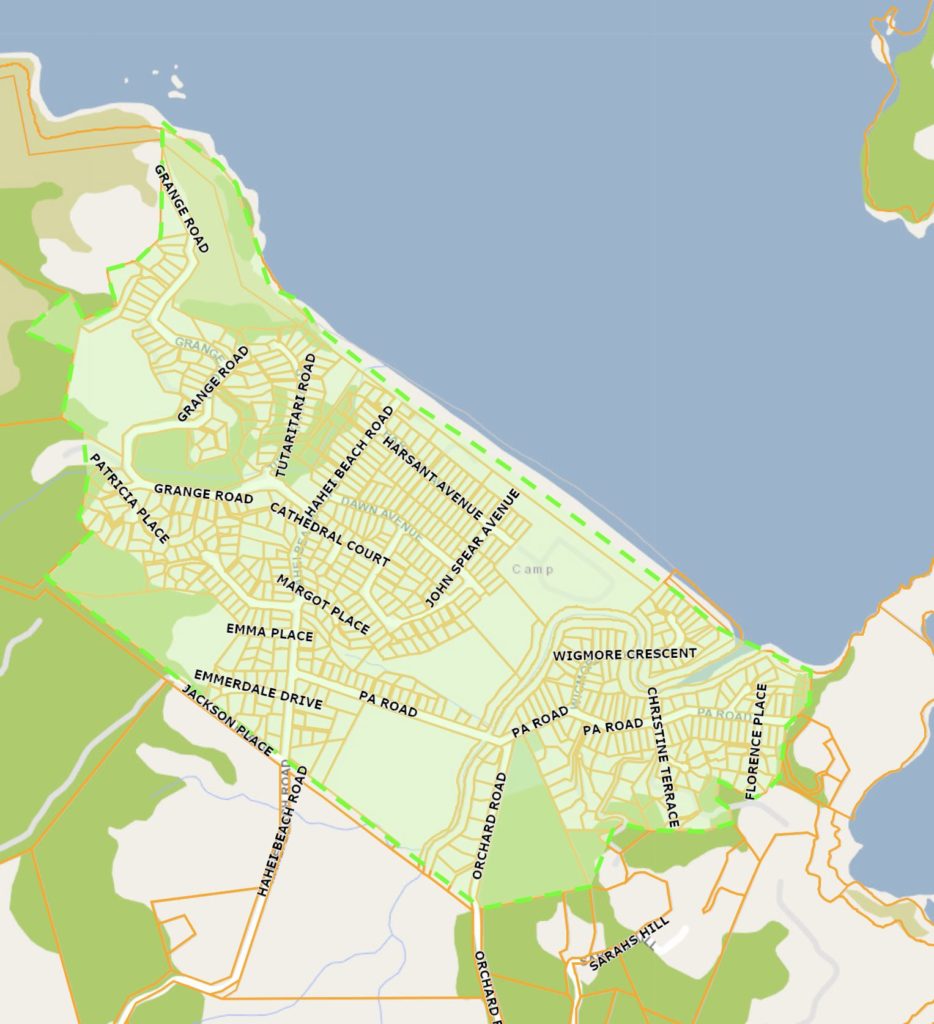
TCDC is responsible for managing storm water in Hahei Village in the area within the green dotted line shown on this map.
Waste Water Treatment Plant report - 2025
Each year, the Hahei Wastewater Treatment Plant (WWTP) is independently monitored to assess its impact on the health of Wigmore Stream. This includes testing water quality and surveying stream life both upstream (before the discharge point) and downstream (after it).
Key Findings: (refer Section 5 Discussion and Conclusions of the report)
- No measurable harm from the treatment plant: Monitoring shows that the treated wastewater discharged into the stream does not cause ecological harm. Conditions upstream and downstream of the discharge point were broadly similar.
- Nutrient levels: While some nutrient levels (such as nitrogen and phosphorus) were higher downstream, the increases were modest and did not appear to affect aquatic life.
- Bacteria levels (E. coli): A key finding was that bacteria levels in the stream were significantly higher than in the treated water coming from the WWTP. In fact, the treated wastewater was cleaner in this regard than the stream itself, as measured both upstream and downstream from the WWTP discharge. This points strongly to contamination from either land use or particularly from septic tanks on properties adjacent to the stream—as the likely source, a view that has been commonly expressed in the community
- Stream life: The variety and abundance of aquatic species in the stream remains limited, mostly due to natural factors such as tidal influence and soft sediment, rather than any effect from the WWTP.
Community Implications:
These results support growing concern among Hahei residents that existing properties close to the Wigmore Stream should be prioritised for connection to the WWTP, to reduce contamination risks and protect stream and beach health. The existing treatment plant has sufficient spare capacity to service all properties adjacent to the stream and these properties should be connected as a priority. It is the view of many in the community —and one we share—that the existing WWTP needs to be upgraded (capacity increased) to enable all residential properties in Hahei (including an allowance for future development) to be connected to the same with the first priority connecting those with ageing septic systems
What’s next?
A new water quality monitoring point has been added on a side stream (upstream of the WWTP outlet) to help trace other potential pollution sources. The report also recommends that Thames-Coromandel District Council review public health signage, given the health risks posed by elevated bacteria levels—unrelated to the WWTP—especially for swimming and shellfish collection in the estuary area.
Sewage
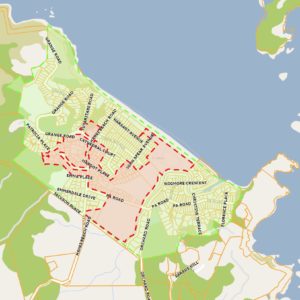
Hahei has a TCDC operated municipal sewage system that provides sewage treatment to 140 properties in Hahei. The area covered shown in the map. Click here for more details.
For details of the treatment plant and its operation, you can download the RMA application prepared by Harrison Grierson, TCDC’s consultants by clicking here. Hahei Sewage System RMA Application. The application was approved and a new Consent was issued that is effective up 2030. You can download the consent here. Hahei WWTP Consent renew2030
The area of Hahei not covered by the TCDC sewage treatment plant has a variety of treatment plants, depending on when the property was developed. Older properties have septic tanks, while more recent builds have modern onsite sewage treatment plants.
Waikato Regional Council Role
In accordance with the Resource Management Act (RMA) the Waikato Regional Council (WRC) has responsibility for monitoring our coastal environment, including stream run off into the ocean.
When discharge consents are issued to organisations such as Thames Coromandel District Council, monitors discharge quality and produces reports annually on specific plans.
WRC has undertakes research in coastal water quality. You can read their most recent report here. 2015 Waikasto Regional Council report
Sewage Treatment Plant Performance
Sewage Treatment Plant Performance 2017/18
Each year, Veolia, TCDC’s plant operator, provides a detailed report of the plants performance. You can download the reports here
- 2017 Report Veolia 2017 Hahei Wastewater Treatment Plant Report,
- 2017 Detailed Data Spreadsheet, 0416 0317 Hahei WWTP Annual Report 117888
- 2018 Report Veolia 2018 Hahei Wastewater Treatment Plant Report.
- 2018 Detailed Data Spreadsheet 0417 0318 Hahei WWTP Annual Report 135636.
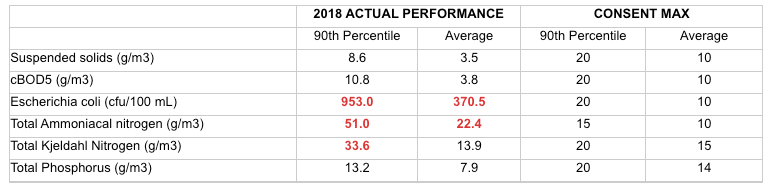
These reports show that the plant was compliant in 2017, but failed to meet required performance standards, as set out in the Discharge Consent, in 2018. Here is a summary
Sewage Treatment Plant Performance WRC Report 2020
Each year, Waikato Regional Council prepares a Compliance Report. You can read the 2020 report here. WRC Site Compliance Report 60462 Hahei WWTP
A summary of WRC’s recommendations are;
- Improvements have occurred for site compliance in this audited period; however, some outstanding matters require action as detailed above
- The plant discharge quality is improving; however, the discharge parameters are not yet in full compliance. It is recommended the abatement notice remain in place until such time that TCDC provides updated data showing compliance with all average and 90th percentile limits. This may be achievable in the near future
- A letter of direction is issued regarding the outstanding matters detailed above
- Do not consider escalation is required for this site based on improved compliance state.
Sewage Treatment Plant Performance Reviews for 2020/21 by Tonkin & Taylor and Veolia
Each year, in accordance with the RMA Consent, TCDC must arrange for Veolia and an independent adviser to report on the sewage treatment plant’s performance. Here are the reports
- Tonkin &Taylor Report. You can download their report here.
210617. Hahei WWTP 2021 Ecological Monitoring Report Final1.
It shows that the plant is operating in accordance with its resource consent. Their only recommendation to TCDC is
“…Veolia notify TCDC of the high coliform bacteria concentrations results so that signage can be checked and reviewed for warnings of swimming and shellfish collection in the estuary mouth.”
- Veolia Reports. You can download their reports here.
2020 21 Hahei WWTP Annual Report 135636 DRAFT
Appendix A 0420 0321 Hahei WWTP Annual Report 135636
Appendix B Hahei WWTP Outflow Meter
Appendix C 135636.01.01 Condition 15 Wigmore Manual Gauging Feb2019
Appendix D 1007585.1010 Hahei WWTP Data Report Final Signed (1)
Appendix E Hahei WWTP Monitoring Implementation Plan 2020 Draft
Waste Water Treatment Plant (WWTP) Documents supplied from TCDC at the time of proposed new subdivision – uploaded March 2025
Consent Documents
Resource Consent Certificate AUTH135636.01.01
Abatement Notice Hahei Wastewater Consent 135636.01.01 18 December 2019 Doc Set # 7218014
2020-2021 Documents
2020 21 Site Compliance Letter & LETTER OF DIRECTION Hahei WWTP
2020 21 Site Compliance Report
2021-2022 Documents
2021 22 Site Compliance Letter Hahei Wastewater
2021 22 Hahei WWTP Annual Report
2021 22 Appendix A 0423 0324 Hahei WWTP Annual Report
2021 22 Site Compliance Report Hahei WWTP
2022-2023 Documents
2022 23 Hahei WWTP Site Compliance Report
2022 23 Appendix A 0423 0324 Hahei WWTP Annual Report
2022 2023 Hahei WWTP Annual Report Consent 135636
2022 23 Hahei WWTP Site Compliance Letter
2023-2024 Documents
Wigmore Stream Water Testing
TCDC has agreed to provide Hahei Residents and Ratepayers Association with water quality test results from the Wigmore Estuary on a regular basis.
Here is a copy of the agreement, HRRA TCDC Water Testing MOU
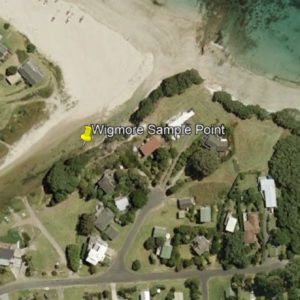
They are taken from the estuary of the Wigmore Stream as shown here.
As agreed in the above Agreement, samples are taken as described in the Wastewater Treatment Plant Resource Consent. This states that “samples to be collected within the period 1 hour either side of local low tide during daylight hours.”
You can download the Wastewater Treatment Plant Resource Consent here. Hahei WWTP Consent renew2030
You can download the December Sample Test results here: Wigmore-sampling-December-2025.pdf
Sampling Location
Getting the Wigmore Stream unblocked.
It is the responsibility of TCDC and Veolia (who is the TCDC Water/Wastewater contractor), to open up the Wigmore Stream when required.
If you see the stream is blocked, ANYONE can file a Request for Service with TCDC by either:
- Email TCDC Customer Services.
- online: CLICK HERE
- or during office hours calling them on 07 868 0200
It will be actioned by an earthmoving contractor, such as Donovan’s after Thames-Coromandel District Council/Veolia authorizes them.
Donovan’s, or any other earthmoving contractor, cannot be engaged to clear the stream by members of the community or community groups.
Summary of Ecological Monitoring at Wigmore Stream (2024–2025)
Each year, the Hahei Wastewater Treatment Plant (WWTP) is independently monitored to assess its impact on the health of Wigmore Stream. This includes testing water quality and surveying stream life both upstream (before the discharge point) and downstream (after it).
You can read the full report here.
Key Findings (refer to Section 5: Discussion and Conclusions of the report)
- No measurable harm from the treatment plant: Monitoring indicates that the treated wastewater discharged into the stream does not cause ecological harm. Conditions upstream and downstream of the discharge point were broadly similar.
- Nutrient levels: Some nutrient levels (such as nitrogen and phosphorus) were slightly elevated downstream; however, these increases were modest and did not appear to impact aquatic life.
- Bacteria levels (E. coli): A key finding was that bacteria levels in the stream were significantly higher than those in the treated wastewater from the WWTP. In fact, the treated water was cleaner in this regard than the stream itself—both upstream and downstream of the discharge point. This strongly suggests that contamination is likely due to land use, particularly ageing septic tanks on properties adjacent to the stream—an issue commonly raised by the community.
- Stream life: The diversity and abundance of aquatic species in the stream remain limited, primarily due to natural factors such as tidal influence and soft sediment, rather than any effect from the WWTP.
Community Implications
These results reinforce growing concerns among Hahei residents that properties near Wigmore Stream should be prioritised for connection to the WWTP to reduce contamination risks and protect both stream and beach health. The existing treatment plant has sufficient spare capacity to service all adjacent properties, which should be connected as a priority.
Many in the community—ourselves included—believe the WWTP should be upgraded (i.e. its capacity increased) to allow all residential properties in Hahei, including future developments, to be connected. The first priority should be those properties with ageing septic systems.
What’s Next?
A new water quality monitoring point has been added on a side stream (upstream of the WWTP outlet) to help identify other potential pollution sources. The report also recommends that Thames-Coromandel District Council review public health signage, given the elevated bacteria levels—unrelated to the WWTP—which pose health risks, especially for swimming and shellfish collection in the estuary area.